In asphalt pavement design, the goal is straightforward: build roads that last longer, perform better, and require fewer repairs. But achieving that balance—especially between cracking resistance and structural capacity—often comes down to how well the mix holds up over time.
One approach that continues to show measurable results in the field is the use of aramid fiber in asphalt mixtures. Across multiple projects and performance evaluations, a consistent pattern emerges. Pavements reinforced with aramid fiber show slower deterioration, reduced cracking, and longer service life.
What the Field Data Shows
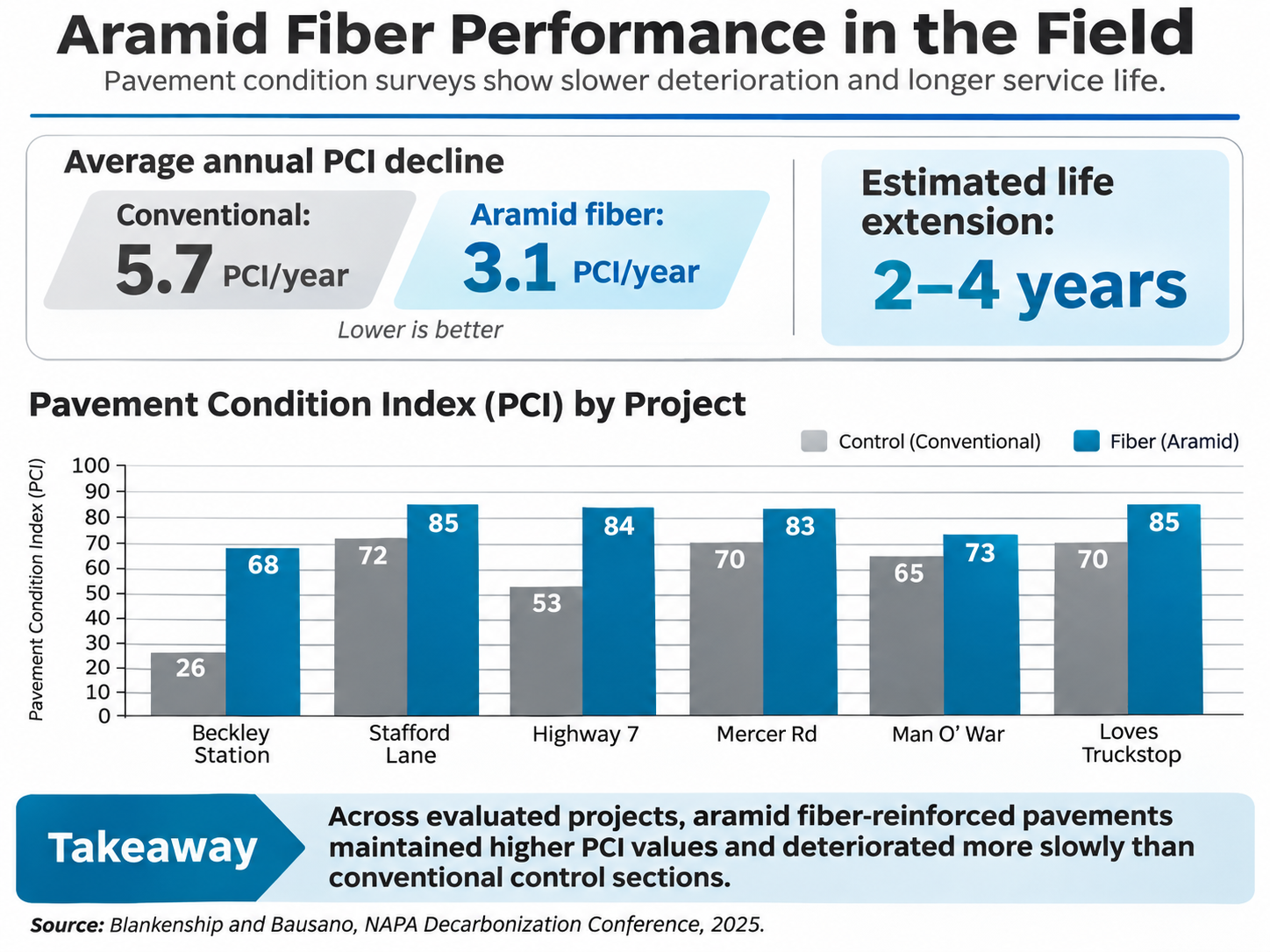
Performance data from several in-service pavements highlights the impact of aramid fiber on long-term pavement condition. In field evaluations conducted by BATT, fiber-reinforced pavements deteriorated at an average rate of 3.1 PCI points annually, compared with 5.7 PCI points for conventional control sections. These findings suggest that aramid fiber reinforcement can significantly slow pavement deterioration, with estimated service-life extensions of two to four years.1
A separate roadway comparison showed similar trends. Several years after construction, the fiber-reinforced section maintained a noticeably higher Pavement Condition Index (PCI) than the conventional control section, demonstrating improved long-term pavement condition.
Across a broader set of projects, performance tracking has shown that fiber-reinforced pavements tend to deteriorate at a slower rate overall. In practical terms, that means more time in good condition and a longer window before maintenance or rehabilitation becomes necessary.
More Than Just Performance—Structural Efficiency
In addition to durability, aramid fiber has also demonstrated value in structural design. Research conducted on a heavily trafficked roadway in Kentucky showed that incorporating aramid fiber reinforcement increased pavement modulus by at least 58% and structural number by at least 20%. These findings demonstrate the potential to reduce pavement thickness while maintaining structural performance requirements.2
For owners, that combination of performance plus efficiency can be a meaningful advantage, particularly on projects where both budget and long-term durability are critical.
Why Life Extension Matters
From an engineering standpoint, the most important benefit is not just improved test results—it’s extended pavement life. When cracking is reduced and deterioration slows, the timeline for maintenance shifts. That means:
Fewer early interventions
Lower life-cycle cost
Reduced disruption to traffic and operations
It also aligns with a growing industry focus on durability as a key component of sustainability. Extending the service life of a pavement reduces the frequency of rehabilitation, which in turn lowers the total materials, energy, and emissions associated with that pavement over time.
Practical Advantages in the Field
Beyond performance, constructability matters. Aramid fiber is introduced during asphalt production and does not require changes to mix design workflows or additional installation steps in the field. That makes it easier to implement compared to reinforcement methods that add complexity during paving operations. For contractors and producers, that simplicity increases the likelihood of consistent results—and repeat use.
A Consistent Track Record
Taken together, the data points to a clear conclusion: aramid fiber is a practical tool for improving asphalt pavement performance. Projects evaluated over multiple years show:
Significant reductions in cracking
Improved pavement condition and slower deterioration over time
Measurable extensions in service life
Lower carbon footprint due to pavement life extension
For agencies, contractors, and owners looking to improve durability without adding complexity, aramid fiber represents a proven option grounded in real-world performance.
References
1. Blankenship, P. B., and Bausano, J. (2025). Evaluating the Environmental Impacts of Aramid Fiber in Asphalt Mixtures: A Cradle-to-Grave Life Cycle Assessment. NAPA Decarbonization Conference, pp. 9–11.
2. Blankenship, P. B., Travis, R., and Rawls Whitby, M. (2024). Fiber Advancements in Structural Design for Perpetual Pavements. NAPA Perpetual Pavement Conference.