Turn Down the Heat. Refine the Feedstock
How NAFCO Achieves 100% RAP Asphalt
With millions of tons of asphalt pavement millings stockpiled across the U.S., the asphalt industry faces growing pressure to turn those materials back into performance-ready pavement. NAFCO (aka necoTECH), based in the Columbus, Ohio area, has met that challenge by producing asphalt mixes using 100% reclaimed asphalt pavement (RAP), more than double the amount in a 2022 industry survey conducted by the National Asphalt Pavement Association (NAPA)*. This achievement is made possible through controlled heat technology and a new philosophy that treats millings as refinable feedstock.
As the survey revealed, RAP asphalt mixtures typically incorporate 10 to 30 percent RAP. NAFCO’s advancement processes RAP using an indirect heating method that prevents scorching or overheating of the asphalt binder. By preserving binder properties, NAFCO can produce high-quality 100% RAP asphalt mixes, an achievement that significantly advances the industry’s ability to turn reclaimed materials into usable pavement.
What makes 100% RAP possible is not just how NAFCO processes the material—it’s how the company defines it. Rather than viewing millings as a single pile of used asphalt, NAFCO has made a paradigm shift to treat millings as a feedstock that must be understood, graded, and categorized within the production system.
The binder within RAP varies based on original mix design, aging, and service conditions. Aggregates vary by source, size, and geology. NAFCO’s process acknowledges these variables and manages them. Millings are separated into multiple stockpiles or streams, each representing different gradations and material characteristics.
By moving away from the “pile of used asphalt” approach, NAFCO creates a system where material inputs are defined, controlled, and aligned with performance targets. That shift is what makes 100% RAP not just achievable—but able to be engineered effectively.
As NAFCO continues to advance its technology, BATT has worked alongside their team with a clear objective: to help establish reproducibility across materials, process, and performance. A key focus has been raw material reproducibility. Millings variability is one of the biggest challenges in high-RAP production, so consistent characterization and sourcing strategies are essential to support predictable mix behavior.
From there, attention turns to process reproducibility. Heating protocols, blending, and additive integration all influence final performance. BATT has helped evaluate and refine these variables to move toward a process that produces consistent results from run to run.
Performance validation is where these efforts come together. Using BMD principles, BATT evaluates mixes for rutting resistance, cracking resistance, and moisture susceptibility to improve and stabilize mix design.
Key finding: 100% RAP mixes are achievable and demonstrate exceptional performance under BMD testing when properly engineered and controlled.
The collaboration also extends beyond individual mix designs to plant-to-plant reproducibility. The broader objective is to help establish reproducible performance so the NAFCO technology can expand into additional markets with consistent results.
NAFCO’s technology offers clear advantages across several applications:
Agencies pursuing sustainability and circular material strategies
Regions seeking to maximize reuse of reclaimed pavement materials
Owners focused on reducing dependence on virgin aggregate and binder
Finally, the technology supports a closed-loop infrastructure model, where existing pavements are reclaimed, reprocessed, and returned to service. This reduces reliance on virgin materials, lowers transportation demands, and contributes to a significant reduction in carbon footprint compared to paving with virgin materials.
NAFCO’s work demonstrates that 100% RAP is not just achievable—it is actively being engineered toward repeatable, performance-driven results helping agencies and producers make a meaningful impact on the growing volume of asphalt millings.
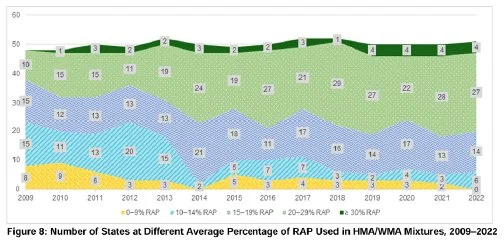
NAPA report Information Series 138 "Asphalt Pavement Industry Survey on Recycled Materials and Warm-Mix Asphalt Usage 2022"
This article was prepared by BATT Lab Manager Zack McKay. He and other members of the BATT team work with agencies, producers, and contractors to evaluate asphalt mixture performance and extend pavement life. He has co-authored numerous peer-reviewed papers on asphalt technology.