How Much RAP Is Too Much for an Asphalt Mix?
The right recycled content depends on the materials, the mix design, and the pavement’s performance requirements.
Reclaimed asphalt pavement (RAP) brings valuable aggregate and asphalt binder back into production, reducing demand for virgin materials. But increasing RAP content also changes the mixture. How far can producers push the percentage before performance problems appear? Here’s the plain truth:
There is no single RAP percentage that separates a good mix from a bad one.
The practical limit depends on the recycled material’s properties, its contribution to the binder blend, the project’s requirements, and the producer’s ability to consistently manufacture and place the mix.
FHWA has documented successful use of mixtures containing 30% to 50% RAP. It has published a best practices document that brings awareness to the possibilities. The results demonstrate what can be achieved with appropriate materials management, design, and quality control; however, they do not establish a universal allowance. The universal that does apply is the governing project specifications.
To achieve the best RAP content, start with the binder contribution
RAP percentage alone does not tell the whole story. Consider two hypothetical mixtures, each containing 30% RAP by total mixture weight and 5% total asphalt binder:
If the RAP contains 4% binder (assuming 100% is utilized), it contributes 1.2 percentage points of binder to the mixture (assuming 100% is utilized), or 24% of the total binder.
If the RAP contains 6% binder, it contributes 1.8 percentage points, or 36% of the total binder.
The RAP percentage is identical, but the amount of recycled binder is substantially different. This is why reclaimed binder ratio, the proportion of total binder supplied by recycled materials, is an important design consideration. These calculations describe the binder present; they do not prove that all of it becomes available and blends uniformly during production.
Binder condition matters, too. RAP from different pavements can contain binders with substantially different aging histories. Its interaction with the selected virgin binder also matters. A percentage that works with one combination of materials may require adjustments when either source changes.
Balance is key
The aged binder in RAP is generally stiffer than unaged binder. That stiffness can increase resistance to wear and climate extremes, but excessive stiffness can leave a mixture vulnerable to cracking.
Selecting a softer virgin binder can help. Texas research found that softer and modified binders could improve cracking resistance in RAP/RAS mixtures while retaining much of their rutting and moisture-damage resistance.1 The appropriate selection, however, depends on the specific materials and application.
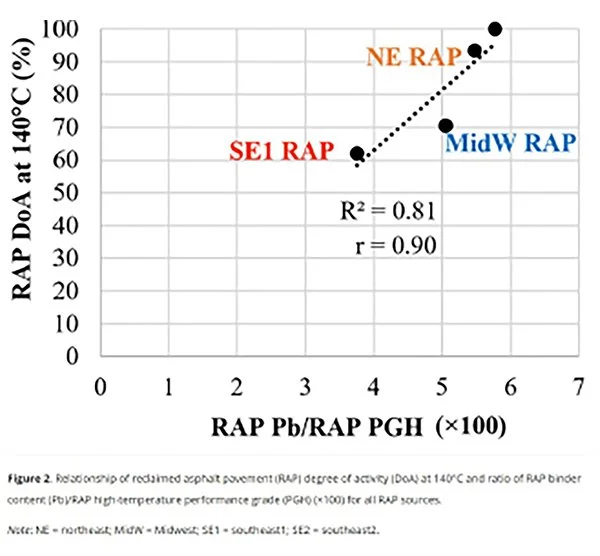
This study also points out that all RAP is not the same and the RAP binder may not all release to be utilized. For example, RAP from the northeast is more available (90+%) to utilize in the mix than RAP from the southeast at about 60%.
Recycling agents offer another potential adjustment, but dosage requires verification. For example, increasing a recycling agent may improve workability and low-temperature performance but can reduce rutting and /or moisture-damage resistance if not balanced. One property cannot be the only measure of success.
Balanced Mix Design helps evaluate these competing needs through mixture performance testing. Cracking, rutting, and moisture-damage results provide evidence for adjusting the combination of recycled material, virgin binder, and additives. BMD testing should reflect the intended application and appropriate conditioning, rather than relying on recycled content or binder grade alone.
Consistency starts in the stockpile
Increasing RAP content makes it especially important to know what is coming out of the stockpile. Variations in binder content and aggregate size change what the RAP contributes to the mixture. If those properties differ substantially from the samples used to develop the mix design, the produced mixture may not perform as expected.
Representative sampling and testing help establish both the RAP’s properties and how much they vary throughout the stockpile. Processing, blending, and careful RAP stockpile management help producers deliver a more uniform material to the plant.
Moisture also needs attention. Wetter RAP requires more energy to dry and heat, which can reduce production rates. Monitoring moisture and managing stockpile drainage help producers maintain consistent operations as RAP content increases.
Considerations for determining the RAP/RAS limit for your mixture
For a producer considering higher RAP/RAS content, the useful question is: What needs to change so this mixture can reliably meet its performance requirements?
That evaluation should address five considerations:
· Materials: Are the RAP/RAS properties sufficiently consistent and well characterized?
· Binder: Is the recycled binder contribution understood, and is the virgin binder appropriate?
· Performance: Does the mixture meet the applicable cracking, rutting, and moisture-damage criteria?
· Production: Can the plant consistently reproduce the design?
· Placement: Can the crew achieve the required density under expected field conditions?
The economic calculation should also include processing, additives, production demands, and anticipated service life. A lower material cost has limited value if premature repairs consume the savings.
This article was prepared byasphalt materials engineer Phil Blankenship, PE, MSCE. He and other members of the BATT Team work with agencies, producers, and contractors to evaluate asphalt mixture performance and extend pavement life. He has authored or co-authored numerous peer-reviewed papers on asphalt technology.